Choosing the Right Stone for Your Countertops
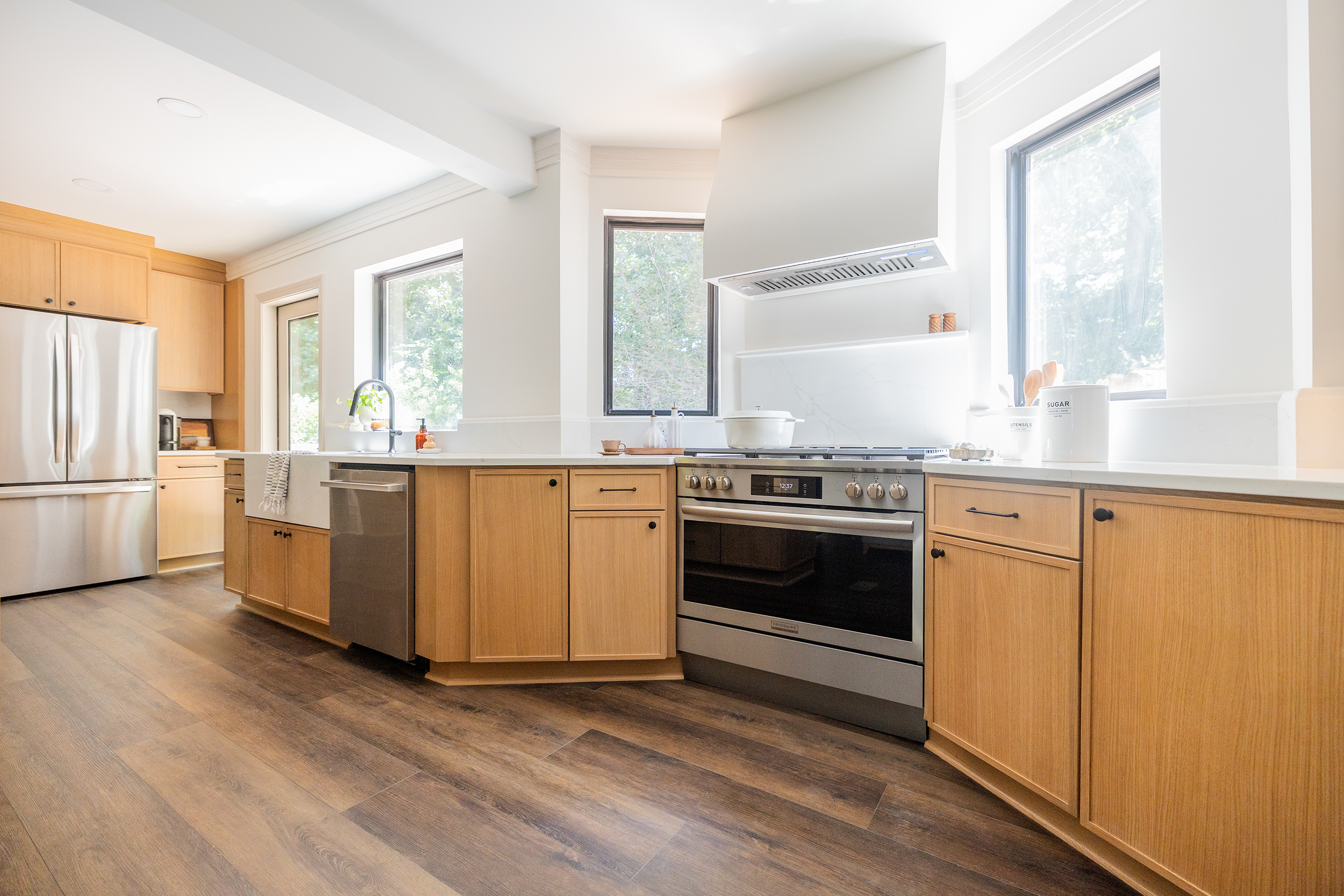
There’s this idea that countertops just exist, sitting plainly on top of our cabinets in our kitchens, bathrooms, laundry rooms, bars, and even outside patios. But selecting the best countertop for you requires way more thought than you may think. While the right material varies for each application, today we’re focusing on natural and engineered stone in the kitchen.
There are more types of stone than you may have noticed, followed by details you may not have considered. We’re here to help you understand your options and hopefully give you a clearer path towards the best slabs for your home.
The Why
Countertops can be made from a variety of materials: laminate, butcher block, stone, porcelain, engineered stone, concrete, tile, and more. At AMD, we prefer stone slabs because they end up eliminating grout lines and have more natural patterns and veinings. This allows more variety in colors and textures that become unique to your home. These slabs can be natural or engineered, both options serving different purposes while still looking beautiful and sophisticated.
First, let’s explore your different options for stone related materials.
Natural Stone:
Marble has had a surge of popularity lately with its elegance and unique veining patterns. This material is great for countertops, but requires regular sealing and maintenance to maintain that refinement in the long run.
Quartzite is generally revered for its resistance to staining and heat. This durability combines with the beauty of pronounced veining and coloring that are perfect for both countertops and flooring.
Dolomite has a naturally beautiful appearance, appropriate for those who want the look of marble but feel more drawn to a natural stone finish. What sets this apart from other materials is how the veining is varied, with no two slabs being the same. However, this can be a downfall if you’re wanting your slab to have a more consistent, uniform pattern.
Granite shines above most of the listed materials, offering a bit more durability. Your knives will not nick and hot pans will not char, unlike other materials such as quartzite. These slabs have mineral patterns, making them highly unique and available in many finishes. Its main setback is price, depending on its grade that varyies between A-C and levels 1-3.
Engineered Stone:
Quartz slabs are extremely popular due to their resistance to stains, cracks, and chips. There’s an endless variety of colors and patterns, swirling together to lean into many aesthetics. Despite its versatility and performance, it is less resistant to heat.
Porcelain is a more recent addition to the market that is usually overlooked despite being nonporous, heat resistant, and durable. If you’re looking for a consistent aesthetic, porcelain is a great choice for you. And, if you want sustainability, porcelain is easily recyclable. The main downfalls are a higher cost and limited options for edge profiles.
Quartz vs Quartzite
Out of the list, we at AMD find our clients leaning more towards quartz and quartzite. There’s a misconception that quartz and quartzite are one in the same, usually based off of name alone. Despite similarities like their durability and strength, they’re quite different.
Quartz:
Engineered stone
Made up of crushed quartz, pigments, and resin
More consistent colors and patterns
Does not require sealing to maintain durability
Quartzite:
Natural stone
Made of mineral quartz
Each slab is unique, with varying patterns and colors
Requires frequent sealing to combat scratching and staining
Anne’s thoughts: Out of all the listed materials, I prefer quartz over natural stone for several reasons. The most prominent reason is that I was a commercial designer for five years before turning to residential. We exclusively used quartz because it was beautiful, yet durable, especially in public spaces. The reason why I continue to specify it for my residential clients is due to its practicality when it comes to children, pets, and everything in between. For those who love wine nights or hosting holidays, this gives you a countertop you’re not afraid to live with.
Finishes and Sealing
Once you’ve chosen your preferred material, there are several options for finishes:
Polished
Satin
Matte
Leathered
The polished finish has a classic beauty to it, its shine becoming a show-stopper in the kitchen. However, with a leathered finish, there’s an emphasis on the stone’s natural texture to speak for itself.
To protect the stone and enhance its longevity, a sealant is applied to the surface. This step is particularly important for porous stones like marble, quartzite, and granite.
Water-based sealant is more budget friendly and better for less dense stone, but solvent-based sealant penetrates deeper and seals it tighter—best used on granite. Despite the increased price for solvent-based, you’re getting more (and longer) results. While water-based gives you about a six month seal, solvent-based lasts up to a year. However, solvent-based ones are not as eco-friendly and often emit strong odors.
Measuring + Selecting Slabs
Now let’s shift to sizing. Before searching for the right slab for you, it’s best to have your countertops measured. During this process, we highly recommend that you don’t measure your countertops yourself. It’s best to have whoever you’re purchasing the slabs from do this in order to ensure precision. If you’re one inch off, that can cause serious issues during installation.
We also advise that you go to slab yards to view these stones in person. Despite what you find online, the color and veining varies depending on the slabs. What you may have once believed to be your perfect countertop may be a head scratcher now.
We recommend bringing a paint deck or samples of your other materials to the stone yard with you. Hold them up against the stone so you can make sure the colors line up with the rest of your kitchen.
Slab Sizing:
Listed below are typical sizing for some of the materials we have mentioned thus far:
Marble ~ Inches: 100″–120″ x 55″–75″ Feet: 8’–10′ x 4.5’–6.25′
Quartzite ~ Inches: 120″–138″ x 65″–78″ Feet: 10’–11.5′ x 5.5’–6.5′
Granite ~ Inches: 108”-132” x 60”-78” Feet: 9’-11’, 5’–6.5′
Quartz ~ Inches: 120″–126″ x 55″–65″ Feet: 10’–10.5′ x 4.5’–5.5′
These can vary based on how much of a slab you are looking for. The types of slabs you can purchase are:
Full Slabs: The entire, uncut piece of stone to reduce seams
Half Slab: A full slab that has been cut in half
Remnants: Leftover fragments unused in other projects from other projects
By Square Foot: Depending on the dealer, some places allow you to purchase and only pay for the exact square footage you use
What size slab you choose can be dependent on your preference for seams. Whether you’re fine with visible lines or desire a very smooth and indiscernible look, it is important to speak to the dealer you’re purchasing from. Depending on both the manufacturer and the stone, your options and results can vary greatly. Ask them about how and where the seams will be placed to be more informed on your installation.
Remaining Questions:
Thinking about installing a slab countertop? Ask yourself these essential questions:
Is my cabinetry strong enough?
Slabs are heavy. Typical cabinetry should be enough to support a stone countertop. However, if there are any overhangs such as at an island or a peninsula, you will need additional support. This is where you would see corbels or hidden steel supports.
What’s my budget?
Defining an overall budget for your countertops before you’ve decided on a specific stone can be tricky. Each material has their own individual cost and no two slabs—or dealers—are going to be the same. This is also dependent on how big of a slab you plan on purchasing. A factor that is often forgotten is the price of sealants, if you choose to use a material outside of quartz and porcelain.
Can I DIY this install?
NO! Slab countertops require expert cutting and installation to avoid mistakes that can result in dangerous risks. Without a warranty to cushion you, you could be looking at costly damages.
How often do I have to seal my countertops?
Each material is different. Here is what we found:
— Marble: every 6-12 months
— Quartzite: every 6-12 months
— Quartz: Never!
— Granite: every 1-2 years
— Dolomite: every 6-12 months
— Porcelain: Never!
When are countertops typically installed?
After all base cabinetry and then before sinks, backsplash (tile), range hoods, and upper cabinets. The reason being that all vertical dimensions are reliant on the height of where the countertop normally sits.
Final Thoughts
Your countertops are a necessary investment, not just for your home, but specifically your kitchen. That’s where your family goes every day to cook, pour juice (or wine), wash dishes, and congregate for homework. It’s a prime location for spills and messes, so it’s important to focus on how stone functions and how much durability you need.
If you are struggling to decide on the right countertop material and veining for your home, we would love to help! Reach out today to set up your Discovery Call.
Ready to Experience the Difference?
If you are ready to approach your renovation with more clarity, structure, and confidence, we would love to guide you through the process.
Reach out to Anne Mason Design today to schedule your Discovery Call!